Diners are asking AI where to eat. Will your venue come up?
Summary
One in three UK 25 to 34-year-olds use AI to find pubs and restaurants. How to get yours recommended, what to fix first, how to check.
In short
How many guests do it: 14% of UK adults have used AI to find a pub or restaurant, and among 25 to 34-year-olds it's 33% (Brew, 2026). Many more meet AI without asking for it: about 30% of Google searches now show an AI summary (Ofcom, December 2025).
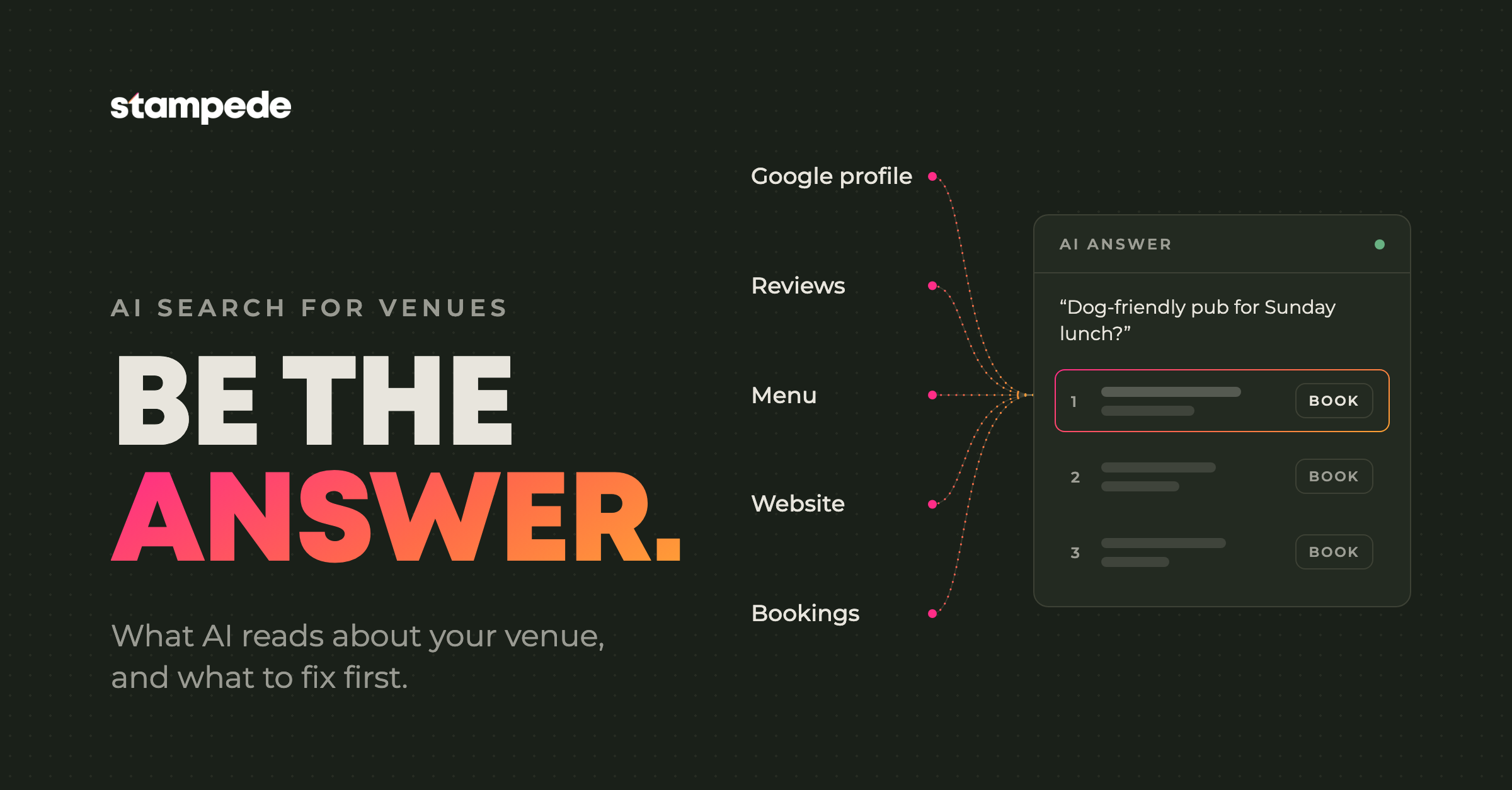
Where the answers come from: AI tools search the web and read what is public about your venue. That means your Google Business Profile, your reviews, your website and menu, and any listings.
What to fix first: your Google profile, a menu with prices on your own website, and a steady flow of recent reviews with a reply under each one.
A guest types "a table for two at a dog-friendly Italian restaurant in Shoreditch for Saturday at 7pm" into Google. They get back a short list of venues with a link to book each one. That is Google's own example from 10 April 2026, when it switched on table booking inside AI Mode in the UK. The guest never scrolls a page of results. A handful of venues get named, and the rest don't come up at all.
You can't buy a place on that list. What you can do is make sure that everything an AI reads about your venue is accurate, complete and recent. This guide covers four things:
how many UK guests already search this way;
where the answers come from;
what to fix first;
how to check what AI says about you today.
How many UK diners use AI to choose where to eat?
A growing minority ask an AI directly, and far more see AI answers without asking. Brew, a hospitality marketing agency, surveyed 1,000 UK adults for its 2026 Pints & Profits report. It found that 14% had used AI to find a pub or restaurant. Among 25 to 34-year-olds, the figure was 33%.
The bigger change is happening inside Google. Ofcom's Online Nation report (December 2025) found that about 30% of searches now show an AI Overview, and 53% of UK adults say they see these summaries often. Most of those people never went looking for AI. Their search engine added it.
ChatGPT is being used more and more like a search engine. OpenAI's own research paper, How People Use ChatGPT (September 2025), found that "Seeking Information" grew from 14% to 24% of all ChatGPT messages between July 2024 and July 2025. The authors describe it as "a very close substitute for web search". Most of that use is personal: 73% of messages in June 2025 had nothing to do with work. By July 2025, 700 million people were using ChatGPT each week.
Guests meet AI answers in three places:
Google Search
- What happens
- An AI Overview summarises an answer above the usual results
- The UK picture
- About 30% of searches show one (Ofcom, Dec 2025)
Google AI Mode
- What happens
- The guest asks in a sentence and gets a shortlist with a link to book
- The UK picture
- Table booking live in the UK since 10 April 2026 (Google)
ChatGPT and other assistants
- What happens
- The guest asks in a sentence and the assistant searches the web for an answer
- The UK picture
- 1.8 billion UK visits to ChatGPT in January to August 2025, up from 368 million a year earlier (Ofcom). Looking things up is now a quarter of all ChatGPT messages (OpenAI, Sep 2025)
| Where the guest meets AI | What happens | The UK picture |
|---|---|---|
| Google Search | An AI Overview summarises an answer above the usual results | About 30% of searches show one (Ofcom, Dec 2025) |
| Google AI Mode | The guest asks in a sentence and gets a shortlist with a link to book | Table booking live in the UK since 10 April 2026 (Google) |
| ChatGPT and other assistants | The guest asks in a sentence and the assistant searches the web for an answer | 1.8 billion UK visits to ChatGPT in January to August 2025, up from 368 million a year earlier (Ofcom). Looking things up is now a quarter of all ChatGPT messages (OpenAI, Sep 2025) |
Google also says searches for "when to book a table" rose 140% in the year to April 2026. Guests are planning further ahead, and more of that planning now goes through an AI answer.
Where do AI answers about your venue come from?
An AI assistant asked where to eat runs a web search and builds its answer from what it finds. That includes your Google Business Profile, your reviews, your own website and menu, listings sites and local press. It can only recommend a venue that search turns up, and it can only describe a venue from what is written down somewhere.
The tools work in slightly different ways. Google's AI Mode sits inside Google Search, and since 10 April 2026 it can take a UK booking through partner booking platforms. ChatGPT rewrites a question into web searches, and OpenAI says local results can come from third-party providers of business listings, which it doesn't name. Neither company publishes how it picks which venues to name.
What matters for a venue is that every source on the list below is public. Most of them are yours to fix.
Google Business Profile
- What an AI can read from it
- Hours, address, category, photos, menu link, booking link, attributes such as dog-friendly or outdoor seating
- Who controls it
- You
Google reviews
- What an AI can read from it
- Rating, how many, how recent, and what guests wrote about the food, service and room
- Who controls it
- Your guests, asked by you. The replies are yours
Your website
- What an AI can read from it
- Menu and prices, what you're known for, private hire, access, a booking page
- Who controls it
- You
Booking page
- What an AI can read from it
- Whether there's a table and how to book it
- Who controls it
- You and your booking provider
Listings and press
- What an AI can read from it
- Whether guides, local news and "best of" lists mention you
- Who controls it
- Partly, through PR
| Source | What an AI can read from it | Who controls it |
|---|---|---|
| Google Business Profile | Hours, address, category, photos, menu link, booking link, attributes such as dog-friendly or outdoor seating | You |
| Google reviews | Rating, how many, how recent, and what guests wrote about the food, service and room | Your guests, asked by you. The replies are yours |
| Your website | Menu and prices, what you're known for, private hire, access, a booking page | You |
| Booking page | Whether there's a table and how to book it | You and your booking provider |
| Listings and press | Whether guides, local news and "best of" lists mention you | Partly, through PR |
What should you fix first?
Start with what guests check most and what is quickest to put right. That means your Google Business Profile, then a menu with prices on your own website, then reviews. Most venues can do the first two in an afternoon. Reviews take months, so start them this week as well.
Get your Google Business Profile right.
Set correct hours, including Christmas, New Year and bank holiday hours, plus the right category, recent photos, a menu link and a booking link.
A wrong closing time sends a guest somewhere else without you ever knowing.
Fill in the attributes (dog-friendly, outdoor seating, step-free access), because guests type their questions in exactly those words.
Put your menu and prices on your website, as text.
Guests ask AI questions like "somewhere under £30 a head with vegan options". An AI can only answer that from prices and dishes it can read.
A menu that only exists as a PDF or a photo is harder for any system to read than one written on the page.
Mark dietary options such as vegan, gluten-free and halal against each dish.
Build a steady flow of recent reviews, with a reply under each one.
Reviews are the most detailed public account of what your venue is like, written by someone other than you.
Ask every guest soon after their visit, and never offer anything in return: fake and incentivised reviews have been illegal in the UK since 6 April 2025, under the Digital Markets, Competition and Consumers Act 2024.
Reply to every review, good or bad. Guests describe your dishes and your room in their own words, which is close to how the next guest will phrase their question.
Stampede does the asking and the replying for you. A feedback request goes out automatically after every visit, and every Google review lands in one inbox with a reply already drafted in your voice. Approve it in a tap, or let replies to good reviews post on their own. Each review also sits on the guest's profile, so you know whether it came from a regular. See how Stampede handles reviews.
Make booking one tap from Google.
Put a Book button on your Google profile, your website and your Instagram. Adding a Book button with Stampede.
When an answer ends in a booking, the venue with the shortest path to a confirmed table has the advantage.
See how many bookings Google sends you. Stampede counts bookings made through Book with Google as their own source. Press ⌘/ in Stampede and ask "What percentage of my bookings came from Book with Google? Show me any trends." You get the share and how it's moving. If Google is sending you more guests, that's where it shows up.
Answer the obvious questions in plain words on your website.
Dog-friendly? Children? Parking? Private hire for 30? Step-free?
Guests ask AI in full sentences, and if the answer isn't written down anywhere, an AI has nothing to give them.
Keep the facts the same everywhere.
Use the same name, address, phone number and hours on your website, Google profile, social accounts and listings.
When two sources disagree, an AI has to pick one, and it may pick the wrong one.
What a steady flow of reviews looks like
Redefining Dining runs 11 venues, including The Welsh House and Cattle & Co, and handles its Google reviews through Stampede.
Reviews: between April and September 2026, its Google reviews grew more than five times over against the six months before.
Rating: its average rating rose from 3.89 to 4.44 stars over the same period.
Replies: its teams have replied to over 830 reviews, typically within about three days.
We can't show that this changed what any AI says about Redefining Dining. Nobody can measure that reliably yet. What it did change is the material every guest, and every AI, now reads about those 11 venues. Read Redefining Dining's story.
How do you check what AI says about your venue?
Ask the questions your guests would ask, in a clean session, and write down what comes back. Repeat the same questions every month. One check tells you little, because answers change from day to day. The same questions asked monthly show you a trend.
We do this for Stampede's own website. Since October 2026 we have put the same set of questions to ChatGPT, Gemini and Google AI Mode every week. Three lessons from that carry straight over to a venue:
Use a clean session. ChatGPT can remember past chats. If you've been asking it about your own venue, it already knows who you are. Use a private window while logged out, or a Temporary Chat with memory switched off.
Ask like a guest. Leave your venue's name out of the first questions, and ask about the occasion, the area and the need. A guest planning Sunday lunch asks about Sunday lunch.
Keep the questions fixed. Change the wording and you can't compare one month with the next.
A starting set for a pub or restaurant:
"Where should I go for Sunday lunch in [town]?"
- What it tells you
- Whether you're named at all for your main occasion
"Dog-friendly pubs with food in [town]"
- What it tells you
- Whether your attributes are known
"Somewhere in [town] for a birthday dinner for 12"
- What it tells you
- Whether you come up for groups and private hire
"Is [your venue] any good?"
- What it tells you
- What it says about you, and which sources it quotes
"What time does [your venue] close on Sunday?"
- What it tells you
- Whether your basic facts are right
| Ask this | What it tells you |
|---|---|
| "Where should I go for Sunday lunch in [town]?" | Whether you're named at all for your main occasion |
| "Dog-friendly pubs with food in [town]" | Whether your attributes are known |
| "Somewhere in [town] for a birthday dinner for 12" | Whether you come up for groups and private hire |
| "Is [your venue] any good?" | What it says about you, and which sources it quotes |
| "What time does [your venue] close on Sunday?" | Whether your basic facts are right |
For each answer, note whether you were named and where in the list. Note what was said and which sources were linked. When a fact is wrong, fix it at the source the AI quoted: usually your Google profile or your website.
What can't you control?
Quite a lot, and it's worth being clear about it:
Placement: you can't guarantee a place in an AI answer.
Consistency: the same question can return different venues on different days.
Personalisation: each tool tailors its answers to the person asking, by location and past searches.
Booking route: booking inside Google's AI Mode runs through the booking platforms Google partners with.
The case for acting anyway is simple. Everything on the fix-first list is work that also helps your Google Maps listing, your website and the guest who reads reviews before booking.
Two cautions:
Be wary of anyone selling a guaranteed place in AI answers. Neither Google nor OpenAI publishes how venues are chosen, so nobody outside them can promise a result.
AI may grow more slowly than the surveys suggest. One in five is still a minority, and half of the 50% "considering it" may never start. If it does stay small, an accurate Google profile, a readable menu and recent reviews still win you bookings through every other channel. The cost of doing the work is low either way.
Where Stampede fits
Stampede covers the parts of this list that are hard to keep up by hand:
Reviews: it pulls your Google reviews into one inbox, drafts a reply to each one in your voice, and sends a feedback request automatically after each visit. See how Stampede handles reviews.
Bookings from Google: guests can book straight from Google through Google Reserve, as they do across ART Hospitality's eight venues.
One guest record: every review and booking lands on the guest's profile.
To see where your reviews stand today, run the free review audit. It reads your Google reviews, compares them with the venues around you, and shows what is pulling your rating down. For more on asking for reviews without breaking Google's rules, read the guide to getting more Google reviews.
Questions operators ask
Can I pay to have my restaurant recommended by AI?
Nobody can guarantee a mention. AI answers are built from what is public about your venue, so the reliable route is to improve that material: your Google Business Profile, your menu and prices, your reviews and your website. Be wary of any service that promises a guaranteed place in AI answers.
Do AI tools read Google reviews?
Google's AI Mode sits inside Google Search, where your Google reviews already live. Other assistants, such as ChatGPT, search the web and can read the review sites and listings they find. Either way, reviews are the most detailed public account of what a venue is like, so keep them recent and answered.
Does my menu need to be on my website?
Yes, as text with prices. Guests ask AI about price and dietary needs in the same sentence, and an AI can only answer from a menu it can read. A menu that exists only as a PDF or an image is harder for any system to read than one written on the page.
How often should I check what AI says about my venue?
Once a month, with the same questions each time, in a clean session (a private window while logged out). Answers vary from day to day, so a single check can mislead. A fixed monthly set shows whether you're being named more often.
Is AI replacing Google for finding restaurants?
For now, much of it happens inside Google. Ofcom found that about 30% of searches show an AI Overview, and Google's AI Mode has taken UK table bookings since April 2026. ChatGPT is growing quickly too, with 1.8 billion UK visits in January to August 2025 against 368 million a year earlier, and OpenAI's own research found a quarter of ChatGPT messages are now people looking things up. The same fixes help in all of them.
See it running on your venues
One unified guest record across Wi-Fi, bookings, reviews and loyalty, and the marketing that acts on it.