How much does a hospitality CRM cost in the UK?
Summary
Hospitality CRM prices checked on UK vendors' own pages, the fees outside the subscription, and what per-cover pricing really costs you.
In short
What you get: a hospitality CRM fills itself from your bookings, guest Wi-Fi and till, and knows each guest's visits and spend. On its own, a general email tool only knows who opened an email.
What it costs: published UK prices start at around £150 to £165 a month per site. Add-on modules cost £10 to £38 a month each, and VAT can be on top. Large groups are often quoted.
What to watch: the pricing model matters more than the headline price. Per-cover and per-contact fees grow with your busiest weeks and your list size.
How to compare: work out the cost per guest you can contact again, and check onboarding fees, add-ons, VAT and data export before you sign.
Plenty of pubs, restaurants and cafés already run their guest marketing on a general email tool. So when a hospitality CRM is pitched, the first question is why it's worth paying for at all. Any price only makes sense once you know what it buys.
This guide starts there: what a hospitality CRM does that a general email tool can't, and when a general tool is enough. Then it works through what a hospitality CRM costs in the UK, the fees that sit outside the subscription, and how to compare quotes.
What does a hospitality CRM do that a general email tool can't?
A hospitality CRM fills itself from your bookings, guest Wi-Fi and till, and knows each guest's visits and spend. On its own, a general email tool only holds the people you upload or who fill in a form, and knows whether they opened an email. That decides who you can reach and whether you can prove a campaign filled tables.
The differences, in the order they matter to most operators:
Getting guests onto the list
- General email tool, on its own
- Sign-up forms and spreadsheet uploads, done by hand
- Hospitality CRM
- Guests added as they book, log in to the guest Wi-Fi or pay
Knowing who your regulars are
- General email tool, on its own
- Opens and clicks
- Hospitality CRM
- Visits, last visit, spend and bookings on each guest's profile
Emails that send themselves
- General email tool, on its own
- Triggered by a sign-up date or a click
- Hospitality CRM
- Triggered by a visit, a birthday, or a guest who hasn't been back for a set number of days
Proving a campaign worked
- General email tool, on its own
- Open and click rates
- Hospitality CRM
- Covers booked and revenue spent by the guests who got it
Guests across several venues
- General email tool, on its own
- A contact per upload, with duplicates
- Hospitality CRM
- One guest profile per guest across every venue
Service on the night
- General email tool, on its own
- Nothing reaches the floor
- Hospitality CRM
- Allergies, preferences and past visits on the booking, in front of your team
Marketing consent
- General email tool, on its own
- Whatever your form captured
- Hospitality CRM
- Recorded per channel at the moment the guest gives it
| What you need | General email tool, on its own | Hospitality CRM |
|---|---|---|
| Getting guests onto the list | Sign-up forms and spreadsheet uploads, done by hand | Guests added as they book, log in to the guest Wi-Fi or pay |
| Knowing who your regulars are | Opens and clicks | Visits, last visit, spend and bookings on each guest's profile |
| Emails that send themselves | Triggered by a sign-up date or a click | Triggered by a visit, a birthday, or a guest who hasn't been back for a set number of days |
| Proving a campaign worked | Open and click rates | Covers booked and revenue spent by the guests who got it |
| Guests across several venues | A contact per upload, with duplicates | One guest profile per guest across every venue |
| Service on the night | Nothing reaches the floor | Allergies, preferences and past visits on the booking, in front of your team |
| Marketing consent | Whatever your form captured | Recorded per channel at the moment the guest gives it |
The first row is the one that changes results. On its own, a general email tool only grows when someone exports a list from the booking system and uploads it, and walk-ins who never book don't reach it. A list that stops growing goes stale, as guests change email address or move on.
The second row is what makes the emails worth sending. "Guests who came in three times last year but not since August" is a segment a hospitality CRM builds from visit data. A general tool can't, because it never saw the visits.
When a general email tool is enough
A general email tool is fine for a single venue that sends a monthly newsletter to a list it already has, and doesn't need to know who visited. Some have a free tier: one we checked is free up to 250 contacts.
It stops being enough when you want to answer questions about guests: who hasn't been back, which regulars spend the most, or whether last month's email filled any tables. Those answers need visit and spend data, and a general email tool doesn't have it.
How much does a hospitality CRM cost per month?
A hospitality CRM costs from about £150 a month per site for a published per-site plan, plus £10 to £38 a month for each add-on module, and VAT can be on top. Large groups are often quoted. What you pay depends on which of five pricing models the vendor uses, so identify the model before comparing numbers.
That range comes from our own check. On 2 November 2026 we read the pricing pages of seven companies selling CRM, guest marketing or bookings-with-CRM to UK hospitality. Two showed a full plan price. Three showed only a "from" price. Two showed no plan price at all.
These are the five models we found, with the published UK figures beside each one:
Flat per site
- How the bill grows
- With each venue you add
- Published UK figures (checked 2 Nov 2026)
- £149 to £165 per site a month, entry level
- Watch for
- Core features in the base price, the rest as add-ons
Per module
- How the bill grows
- With each tool you switch on
- Published UK figures (checked 2 Nov 2026)
- From £15 to £16 per venue a month per module (reviews, feedback or product ratings)
- Watch for
- A full set of modules adds up line by line
Per contact
- How the bill grows
- With the size of your guest list
- Published UK figures (checked 2 Nov 2026)
- Free up to 250 contacts on one email tool, then priced by contact tier
- Watch for
- You pay more as your list grows, whether or not you email those guests
Per cover
- How the bill grows
- With every guest booked
- Published UK figures (checked 2 Nov 2026)
- Not on any pricing page we checked. Ask for it in writing
- Watch for
- The bill rises on your busiest weeks
Quote only
- How the bill grows
- Set on a sales call
- Published UK figures (checked 2 Nov 2026)
- No figures
- Watch for
- You can't compare until you've sat through a demo
| Pricing model | How the bill grows | Published UK figures (checked 2 Nov 2026) | Watch for |
|---|---|---|---|
| Flat per site | With each venue you add | £149 to £165 per site a month, entry level | Core features in the base price, the rest as add-ons |
| Per module | With each tool you switch on | From £15 to £16 per venue a month per module (reviews, feedback or product ratings) | A full set of modules adds up line by line |
| Per contact | With the size of your guest list | Free up to 250 contacts on one email tool, then priced by contact tier | You pay more as your list grows, whether or not you email those guests |
| Per cover | With every guest booked | Not on any pricing page we checked. Ask for it in writing | The bill rises on your busiest weeks |
| Quote only | Set on a sales call | No figures | You can't compare until you've sat through a demo |
Most venues end up on a mix. A booking system priced per cover, an email tool priced per contact and a review tool priced per module is a common stack, and each bill grows for a different reason.
Why do so few hospitality CRMs publish a full price?
Five of the seven pricing pages we checked showed no full plan price: two showed none, and three showed only an entry "from" figure. The pages that explain why say the price is built from your estate: site type and size, booking volume and the modules you need.
That's not always bad faith. A five-site group and a single café need different things. But it moves the work onto you, so go into the first call with these questions:
What is the monthly price per site, and is it before or after VAT?
Which features are in that price, and which are add-ons?
Is there a one-off onboarding or setup fee?
Is there any fee per cover, per booking, per contact or per message?
How long is the contract, and what does it cost to leave early?
If I leave, can I export every guest record and their consent, and in what format?
If a vendor won't put the answers in writing, treat the quote as incomplete.
How do per-cover fees change the cost?
A per-cover fee charges you for each guest booked, so the bill rises with your best weeks. A venue taking 1,200 online covers a month pays £1,200 a month at £1 a cover. A flat-priced platform costs the same in December as in January.
Per-cover fees come up regularly on our sales calls. One operator described a fee of "two pounds per reservation per cover, it's quite a lot." Another told us their monthly bill had jumped from £120 to £750.
Here is the arithmetic for a range of fees and volumes. The fee levels are illustrative. Use your own.
500
- At 50p a cover
- £250
- At £1 a cover
- £500
- At £2 a cover
- £1,000
1,200
- At 50p a cover
- £600
- At £1 a cover
- £1,200
- At £2 a cover
- £2,400
2,500
- At 50p a cover
- £1,250
- At £1 a cover
- £2,500
- At £2 a cover
- £5,000
| Online covers a month | At 50p a cover | At £1 a cover | At £2 a cover |
|---|---|---|---|
| 500 | £250 | £500 | £1,000 |
| 1,200 | £600 | £1,200 | £2,400 |
| 2,500 | £1,250 | £2,500 | £5,000 |
Check which covers the fee applies to: covers that arrive through the provider's own diner app or network, bookings made on your own website, or both. Ask too whether a repeat guest who books again through the network is charged again.
What costs sit outside the subscription?
The subscription is usually the smallest surprise. These are the costs we found on vendors' own pricing pages that sit outside the headline monthly price:
Onboarding. One-off setup or onboarding fees, sometimes listed without an amount.
Add-on modules. £10 to £38 a month each, for things like SMS, vouchers, surveys, pre-orders or integrations.
Integrations. Connecting your till or property system can be its own monthly line (£10 a month per integration on one page we checked).
Payment surcharges. A percentage on deposits or gift vouchers taken through the system (1.2% on deposits on one page we checked), plus your card processor's fee.
Messaging. SMS is often a monthly add-on, and some systems charge per message on top.
VAT. Two of the pages we checked add VAT on top, and the rest don't say. Ask, and budget for 20% unless the quote includes it.
Your team's time. Exporting a list from one tool and uploading it to another every week is a cost, even if no invoice shows it.
Put every line into one annual figure per venue before you compare. Our stack calculator on the pricing page does that for bookings, marketing, loyalty, reviews and Wi-Fi.
How do you work out the real cost per guest?
The real cost of a hospitality CRM is the monthly cost divided by the number of guests it lets you contact again. Two systems at the same price can differ a lot on that measure, because they capture different guests.
A booking-only CRM records the person who made the booking, usually one name per table. Walk-ins and the other guests at the table never reach it. A CRM that also captures guests when they log in to your guest Wi-Fi, or that matches till payments to a profile, reaches people a booking system can't.
The sum is simple:
Cost per contactable guest = total monthly cost ÷ new guests with marketing consent added that month
An illustrative example: £300 a month that adds 200 contactable guests costs £1.50 per guest. The same £300 adding 600 guests costs 50p per guest. Ask any vendor for the second number, guests added with consent, and they'll usually need your data to answer. Ask anyway.
Only count guests who opted in to marketing. A record you can't legally email isn't a contact you can bring back.
Is a CRM worth it for a single-location restaurant?
A CRM is worth it for a single-site restaurant when the repeat visits it brings back are worth more than its monthly cost after your gross profit. For most independents that means it has to bring back a handful of extra tables a month, so the question is whether you'll actually use it.
The break-even sum: if a CRM costs about £300 a month and your average spend per head is £30, it needs ten extra guest visits a month to cover its cost in takings. Takings aren't profit, so divide the monthly cost by your gross profit per guest instead. That gives the honest number.
When a CRM isn't worth it yet:
Nobody will send anything. A guest list without a monthly email or an automated win-back email to lapsed guests costs money and returns nothing.
Your guests don't come back. A venue that serves mostly one-off tourist trade has a small pool to re-market to.
You have no way to capture guests. If most guests walk in and you take no bookings, run no guest Wi-Fi and don't match payments, the CRM stays empty.
If none of those applies, start with what a CRM does automatically: a thank-you after a visit, a birthday message, a win-back email to guests who haven't been in for, say, 60 days. Those run without anyone remembering to send them.
How Stampede prices its CRM
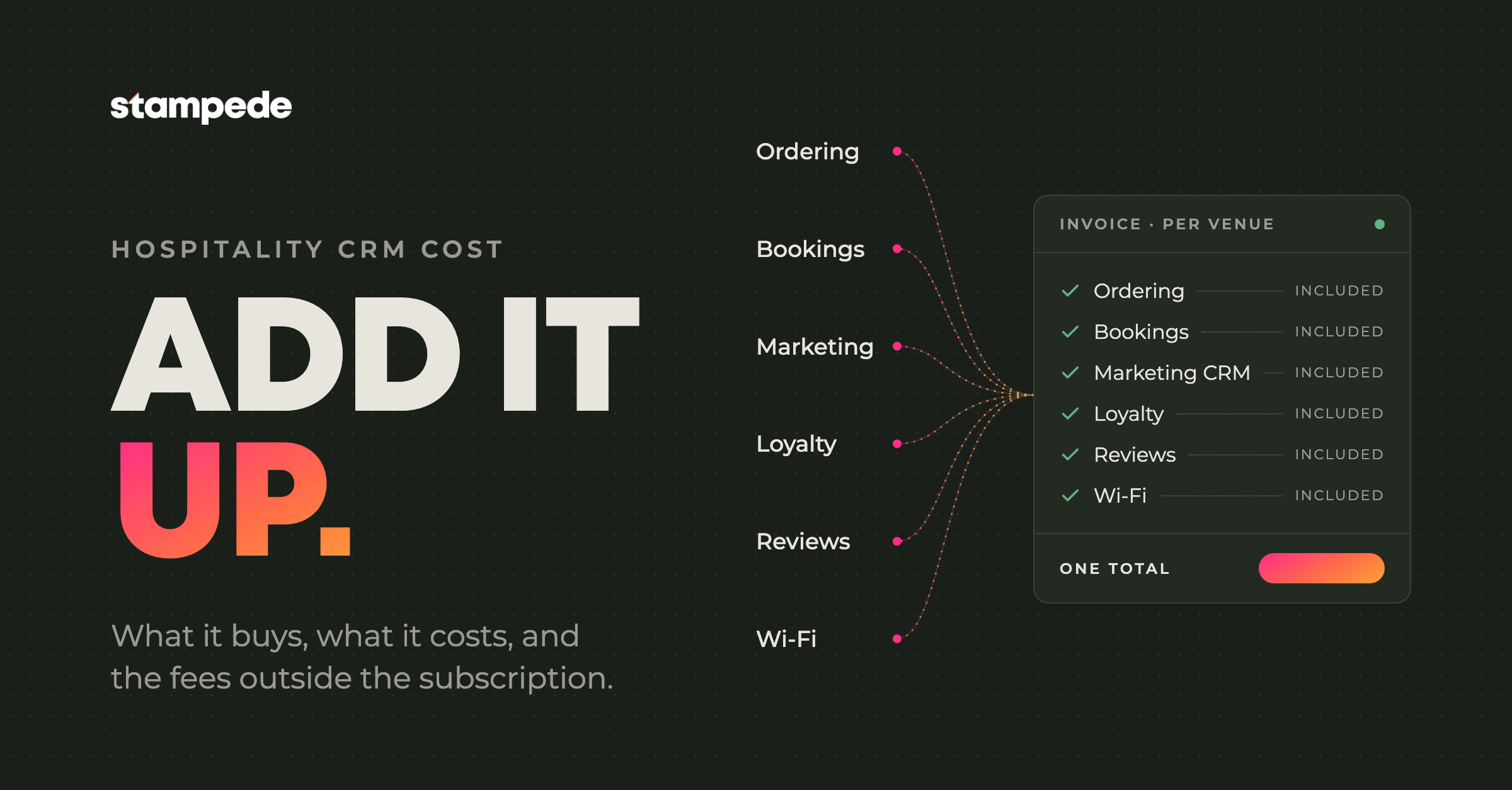
Stampede charges one flat price per venue for the whole platform: guest profiles and marketing CRM, table bookings, email and SMS, loyalty, reviews, guest Wi-Fi and ordering. There are no per-cover or per-booking fees, and onboarding is included.
£0 per cover. A full Saturday costs the same as a quiet Tuesday.
SMS is the one per-message cost. Texts run on prepaid credits at a few pence each. There's no per-email fee, so a bigger list doesn't mean a bigger bill.
The full suite starts from £299 a month per venue. Groups are priced on one call, sized to the estate.
Your guest data stays yours. Every guest you capture is yours to keep and export at any time.
Two-way Square sync. A booking carries through to the table on Square, and the spend comes back to the guest's profile, so you can see what each guest is worth.
The trade-off: a flat price suits venues that take most of their bookings directly and want to own their guest list. If most of your covers come from a third-party diner app, keep that channel for discovery and run your direct bookings and guest marketing on a platform you own.
To see what you pay today, add up your current stack. To see how separate tools compare with one platform, read one hospitality platform or separate systems and run our restaurant tech stack audit.
Hospitality CRM cost FAQs
Do hospitality CRMs charge per cover?
Some do. Per-cover fees are most common on booking platforms with a consumer diner network, and the rate may not be on the pricing page. Ask whether the fee applies to network bookings, bookings on your own website or both, and whether repeat guests are charged again.
Is there a free hospitality CRM?
Some email marketing tools are free for a few hundred contacts, and one we checked is free up to 250. Free plans stop at a contact limit and, on their own, don't capture guests from bookings, Wi-Fi or the till, so a venue outgrows them quickly.
Are hospitality CRM prices quoted with VAT?
Often not, and many pages don't say. Two of the seven UK pricing pages we checked add VAT on top, and the other five don't mention it. Ask, and budget for 20% unless the quote says VAT is included.
Can I take my guest data with me if I change CRM?
You should be able to, and you should check before you sign. Ask whether you can export every guest record with its marketing consent and visit history, in a standard format, at any time, and whether the vendor charges for it.
Is a hospitality CRM cheaper than separate tools?
--- ---
See it running on your venues
One unified guest record across Wi-Fi, bookings, reviews and loyalty, and the marketing that acts on it.