Order and pay at the table: QR ordering for Square venues
Summary
Order and pay at the table for UK venues on Square. Guests scan, order and pay, and every order lands on a guest profile you own. See how it works.
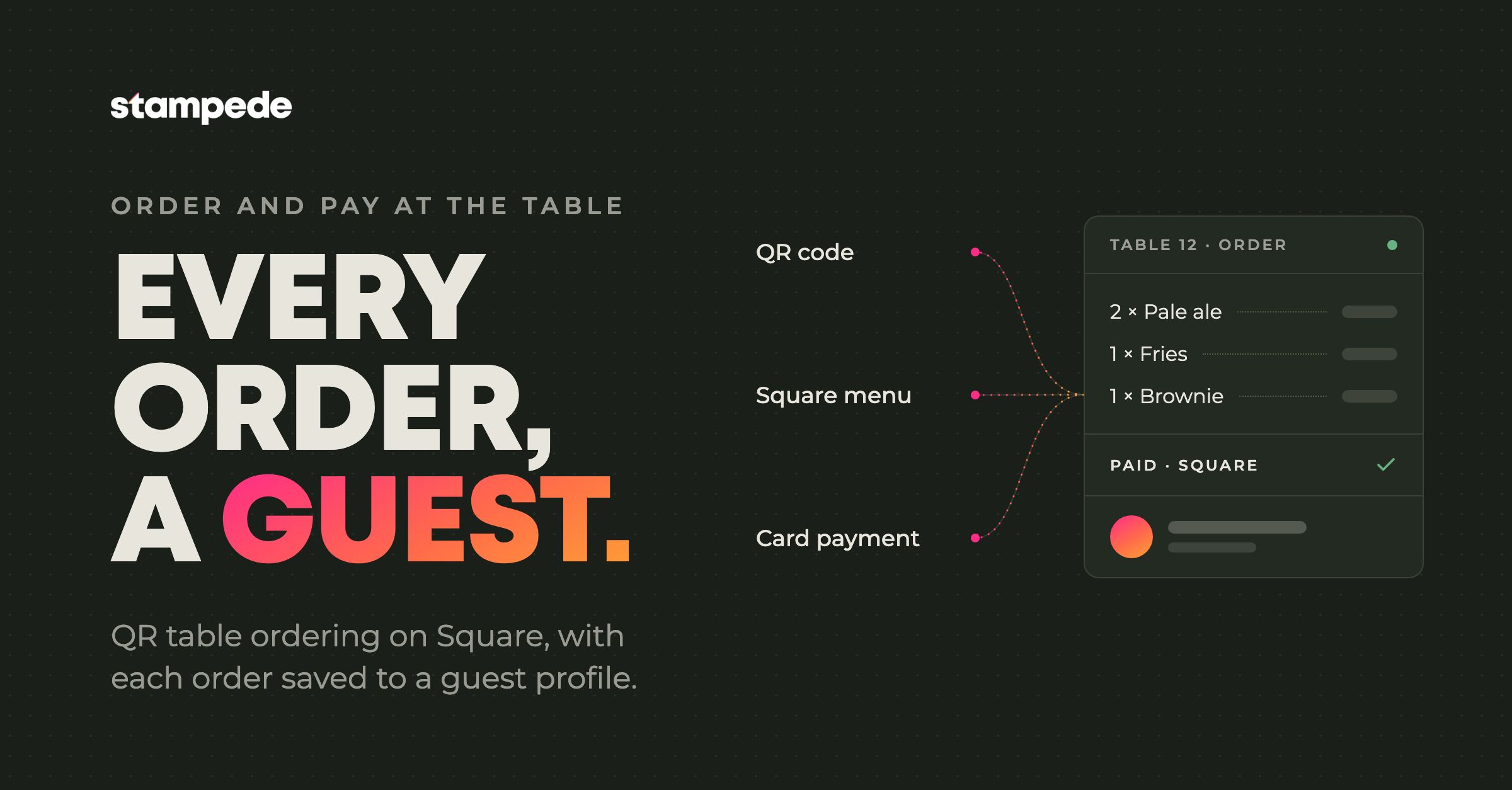
Stampede's table ordering lets guests at UK venues on Square order and pay at the table from their phone. They scan a QR code, order from the venue's Square menu and pay by card. Each order reaches the Square Point of Sale tagged with its table and is saved to a guest profile the venue owns. It went live on 30 August 2026 and has had five releases since.
In short
Order and pay at the table means a guest scans a QR code at their table, orders from the venue's menu in their phone's browser and pays by card, with no app to download.
Stampede's table ordering went live on 30 August 2026 for UK venues that use Square, and each paid order reaches the Square Point of Sale tagged with its table.
The menu a guest sees in Stampede's table ordering is the venue's own Square catalogue, so items, prices and modifiers are kept up to date in one place.
A guest using Stampede's table ordering gives their details once, and every order they place after that lands on the same guest profile, alongside their bookings, Wi-Fi sign-ins and reviews.
Stampede charges one flat price per venue for the whole platform, with no per-cover fees, so the price does not change with how many orders come through table ordering.
What does order and pay at the table mean for a UK venue?
For a UK venue, order and pay at the table means the guest orders and pays from their own phone, and staff make and serve the order. Venues set it up in one of three ways:
Order and pay at the table
- What the guest does
- Scans, orders and pays, and the order is brought over
- What it suits
- Pubs, casual dining, busy terraces
Order at the table, collect from the counter
- What the guest does
- Scans, orders and pays, and collects when it's ready
- What it suits
- Food halls, beer gardens, counter-service cafes
Collection for later
- What the guest does
- Orders ahead for a time slot, today or up to seven days ahead
- What it suits
- Takeaway alongside a dining room
| Setup | What the guest does | What it suits |
|---|---|---|
| Order and pay at the table | Scans, orders and pays, and the order is brought over | Pubs, casual dining, busy terraces |
| Order at the table, collect from the counter | Scans, orders and pays, and collects when it's ready | Food halls, beer gardens, counter-service cafes |
| Collection for later | Orders ahead for a time slot, today or up to seven days ahead | Takeaway alongside a dining room |
Stampede gives each venue separate links for ordering at the table and ordering to collect, and each link can carry its own menu at its own prices.
How does QR table ordering work with Square?
QR table ordering with Square works in four steps, and the order ends up on the Square Point of Sale and on the guest's profile.
The guest scans the code. The code on the table opens the venue's menu in the phone's browser. Nothing is downloaded.
The guest builds their order. The menu is the venue's live Square catalogue, with categories, prices, photos and modifier rules. If a required choice is missing, such as the size of a glass of wine, the menu says which one before the item goes in the basket.
The guest pays by card through Square. Before any card is charged, Stampede recalculates the total from the venue's own menu data, so the amount taken is always the venue's price.
The order goes to Square and onto the guest profile. The paid order reaches the Square Point of Sale tagged with its table, and Stampede saves it to that guest's profile.
Because the Square integration is two-way, the same guest profile also carries that guest's bookings, and the spend from any table they book comes back from Square onto their record.
Two more details:
A shared basket. One guest can send the basket link round the table, everyone adds their own items, and one order goes to the point of sale.
Alcohol. A basket that contains alcohol asks the guest to confirm their age before it reaches checkout. Staff still check ID when they bring the drinks over, in line with your Challenge 25 policy.
One QR code per table, or one per venue?
Most venues are best served by a single venue QR code with a table picker, because it never needs reprinting when the floor plan changes. A code per table saves the guest one tap, but every move of a table means printing a new code.
What the guest does
- One code per table
- Scans and goes straight to the menu
- One venue code
- Scans, picks their table, then sees the menu
When tables change
- One code per table
- Reprint the affected codes
- One venue code
- Nothing to reprint
Best for
- One code per table
- Fixed floor plans, table numbers set in stone
- One venue code
- Terraces, events, rooms that are rearranged
| One code per table | One venue code | |
|---|---|---|
| What the guest does | Scans and goes straight to the menu | Scans, picks their table, then sees the menu |
| When tables change | Reprint the affected codes | Nothing to reprint |
| Best for | Fixed floor plans, table numbers set in stone | Terraces, events, rooms that are rearranged |
In Stampede, every code downloads as a PNG named after the venue and table, so they are ready to send to a printer.
Where does the order data go?
Every table order in Stampede lands on a guest profile that belongs to the venue, so the order history builds into a list of named guests the venue can recognise and contact again.
With Stampede, a guest gives their name and email once when they start an order. From then on, each order they place joins the same profile as their bookings, their Wi-Fi sign-ins and their reviews. For a venue, that means three practical things:
Regulars are named. A guest's table orders build into an order history on their profile, so a regular is a named guest with a record of what they order.
Marketing has something to work from. A guest who orders at the table, books a table next month and joins the Wi-Fi the month after is one person in Stampede, with one set of consents.
Loyalty counts at the table. Loyalty members can turn their points into a Square gift card and spend it at table-ordering checkout, several on one order if they have been saving.
When is table ordering the wrong fit?
Table ordering is the wrong fit when being served is the thing guests are paying for: a tasting menu, a special occasion, or a dining room where the server's recommendation sells the wine. In those rooms a QR code on the table can read as a cut in service.
Edwin Kirk, founding director of ART Hospitality, runs eight chef-led restaurants on Stampede. In ART's case study, he describes restaurants weighing up self-service kiosks or QR ordering and wanting neither, because both are clunky, cost money and are one more system to train staff on. ART has QR ordering on its list of things to switch on next.
Table ordering can run alongside table service:
Staff take the first order. The first drinks and the mains go through a person.
The code handles the rest. Dessert, the second bottle and the round at 9pm go through the code when nobody is passing.
One menu, one system. Because the menu is the Square catalogue staff already use, there is no second menu to keep in step and no new point of sale.
You can read more about how ART runs eight venues on one guest profile in the ART Hospitality story.
How much does order and pay at the table cost with Stampede?
Stampede charges one flat price per venue, with no per-cover fees, so the price stays the same however many orders come through the table. Guests pay by card through Square, and on a menu that spans several venues, the venue chooses which one takes the payment.
What shipped, and when
Table ordering has had five more releases since launch, and every one is dated on the public feature log.
30 August
- Release
- Table ordering on Square: scan, order, pay, and the order reaches the point of sale with its table
31 August
- Release
- Guests give their details once, and every order lands on their guest profile
8 September
- Release
- One menu across several venues and Square accounts, with one basket and one payment
24 September
- Release
- Ask the menu in a sentence, such as "two kids and someone vegan"
2 November
- Release
- Collection checkout asks guests when they're coming
4 November
- Release
- Collection orders taken up to seven days ahead
| Date (2026) | Release |
|---|---|
| 30 August | Table ordering on Square: scan, order, pay, and the order reaches the point of sale with its table |
| 31 August | Guests give their details once, and every order lands on their guest profile |
| 8 September | One menu across several venues and Square accounts, with one basket and one payment |
| 24 September | Ask the menu in a sentence, such as "two kids and someone vegan" |
| 2 November | Collection checkout asks guests when they're coming |
| 4 November | Collection orders taken up to seven days ahead |
The multi-venue menu and menu search each have their own post: One menu, several venues, one payment and The whole menu, answered in one search. For the full feature list, see the table ordering page.
Order and pay at the table FAQs
Can a whole table order on one bill with QR ordering?
Yes. One guest can share the basket link with the rest of the table, everyone adds their own items, and the table sends one order to the Square Point of Sale.
Do staff still need to take orders if we use order and pay at the table?
That is up to the venue. Many venues have staff take the first order in person and leave the QR code for extra rounds and desserts, so table ordering adds orders without replacing table service.
Can I sell different items at the table and for collection?
Yes. Each venue has separate links for ordering at the table and ordering to collect, and each one can carry its own menu at its own prices.
Can loyalty members spend their points when they order at the table?
Yes. Members can turn their points into a Square gift card, and table-ordering checkout accepts those gift cards, several on one order. An order fully covered by gift cards needs no card payment.
How does QR ordering stop under-18s ordering alcohol?
A basket that contains alcohol asks the guest to confirm their age before it reaches checkout. That is a self-declaration, so staff should still check ID when they bring the drinks to the table, as they would at the bar.
See it running on your venues
One unified guest record across Wi-Fi, bookings, reviews and loyalty, and the marketing that acts on it.