Pay at table in the UK: 7 things to check before you switch it on
Summary
Switching on pay at table in the UK? Check the POS, guest fees, split options, card holds, tips and guest data. See how it works on Square.
Pay at table lets guests at a UK restaurant or pub scan a QR code on their table, see the bill from the venue's point of sale, split it and pay from their phone. Stampede's pay at table is a feature of the Stampede platform for venues on Square. This guide sets out the seven things to check before you switch pay at table on, whichever provider you use, in order of what goes wrong first.
In short
Pay at table should read the open bill from the venue's own point of sale and close it there once it is paid, so staff have nothing to reconcile at the end of the night.
Some pay at table providers' terms allow a service fee to be added to the guest's payment, so a UK venue should read the guest terms as well as its own pricing page before signing.
Pay at table needs at least five ways to split a bill: the whole bill, each guest's own items, equal shares, a set amount and whatever is left.
Under the Employment (Allocation of Tips) Act, in force since 1 October 2024, tips and service charges paid by card must reach staff in full, by the end of the following month, so pay at table must record every tip it takes.
Stampede's pay at table runs on Square: guests pay the open check on Square Point of Sale, no fee is added to their bill, and every guest who pays lands on a guest profile the venue owns.
Why are UK venues adding pay at table?
UK venues are adding pay at table because nearly every bill is already paid by card, and the slowest part of a card payment is waiting for the machine. Card payments made up 64% of all UK payments in 2025, and cash fell to 8% (UK Finance, UK Payment Markets 2026).
At the end of a meal, a table that wants to leave needs a member of staff three times: to ask for the bill, to bring the card machine, and again when the table splits it four ways. Pay at table turns those three visits into none. The guest pays when they are ready, and the server spends the time on the tables that are still ordering.
1. Does it pay the real bill on your point of sale?
The first thing to check is where the bill comes from. Good pay at table reads the open check on your point of sale live, by table, and closes the order there when the bill is covered. If it does not, someone has to re-key or reconcile every QR payment against the POS at close.
Ask the provider three questions:
Which POS does it read from? Check yours is on the provider's own published partner list, not "coming soon".
Does it update live? If a round is added at the POS after a guest opens the bill, the guest should see the new total before they pay.
Who closes the order? The POS should close it once the bill is covered, without a member of staff touching it.
With Stampede, the bill a guest sees is the open check on Square Point of Sale, found by its table name. When the bill changes at the POS, every phone at the table updates, and a guest who is part way through paying is shown the new amount and asked to agree to it first. Once the bill is covered, Square closes the order.
2. Will your guests be charged a fee to pay?
Check whether the provider adds a fee to the guest's payment. Some pay at table providers' terms allow a service fee, calculated on the amount paid, to be added when a guest pays by QR. Diners have complained on social media about being charged extra to pay their own bill, and the complaint lands on the venue, because the venue's name is on the bill.
The fee is rarely on the venue pricing page. It sits in the terms the guest accepts when they pay, so read both documents before signing:
Fee added to the guest's payment
- Who pays it
- Your guest
- Where to find it
- The guest terms of use, not the venue pricing page
Monthly or per-venue fee
- Who pays it
- The venue
- Where to find it
- The provider's pricing page
Card processing rate
- Who pays it
- The venue
- Where to find it
- Your contract, or your payment provider's pricing
Printed QR codes
- Who pays it
- The venue
- Where to find it
- Some providers charge per code
| Cost | Who pays it | Where to find it |
|---|---|---|
| Fee added to the guest's payment | Your guest | The guest terms of use, not the venue pricing page |
| Monthly or per-venue fee | The venue | The provider's pricing page |
| Card processing rate | The venue | Your contract, or your payment provider's pricing |
| Printed QR codes | The venue | Some providers charge per code |
Stampede adds no fee to the guest's bill. Guests pay what is on the bill plus any tip they choose, and nothing else. Card payments go through your own Square account at your Square rates, every table QR code downloads free as a PNG ready to print, and Stampede charges one flat price per venue for the whole platform, with no per-cover fees.
3. How many ways can guests split the bill?
Pay at table is only faster than the card machine if it handles every way a table actually splits. Check for five methods:
Pay the whole bill
- When a table uses it
- One person is paying for everyone
Pay for your own items
- When a table uses it
- Mixed orders, such as one guest who only had a starter
Equal shares
- When a table uses it
- Friends who agree to split it evenly
A set amount
- When a table uses it
- "I'll put £40 in"
Pay what is left
- When a table uses it
- The last guest settles the remainder
| Split method | When a table uses it |
|---|---|
| Pay the whole bill | One person is paying for everyone |
| Pay for your own items | Mixed orders, such as one guest who only had a starter |
| Equal shares | Friends who agree to split it evenly |
| A set amount | "I'll put £40 in" |
| Pay what is left | The last guest settles the remainder |
Stampede has all five, and everyone at the table sees who has paid and what is left, live. Large Christmas party bookings are where this matters most, because a table of twelve rarely splits one way.
4. When is each guest's card charged?
Ask the provider what happens between the first guest paying and the last. If each card is charged the moment its owner taps pay, a venue can end up with eleven paid shares and one guest who has already left.
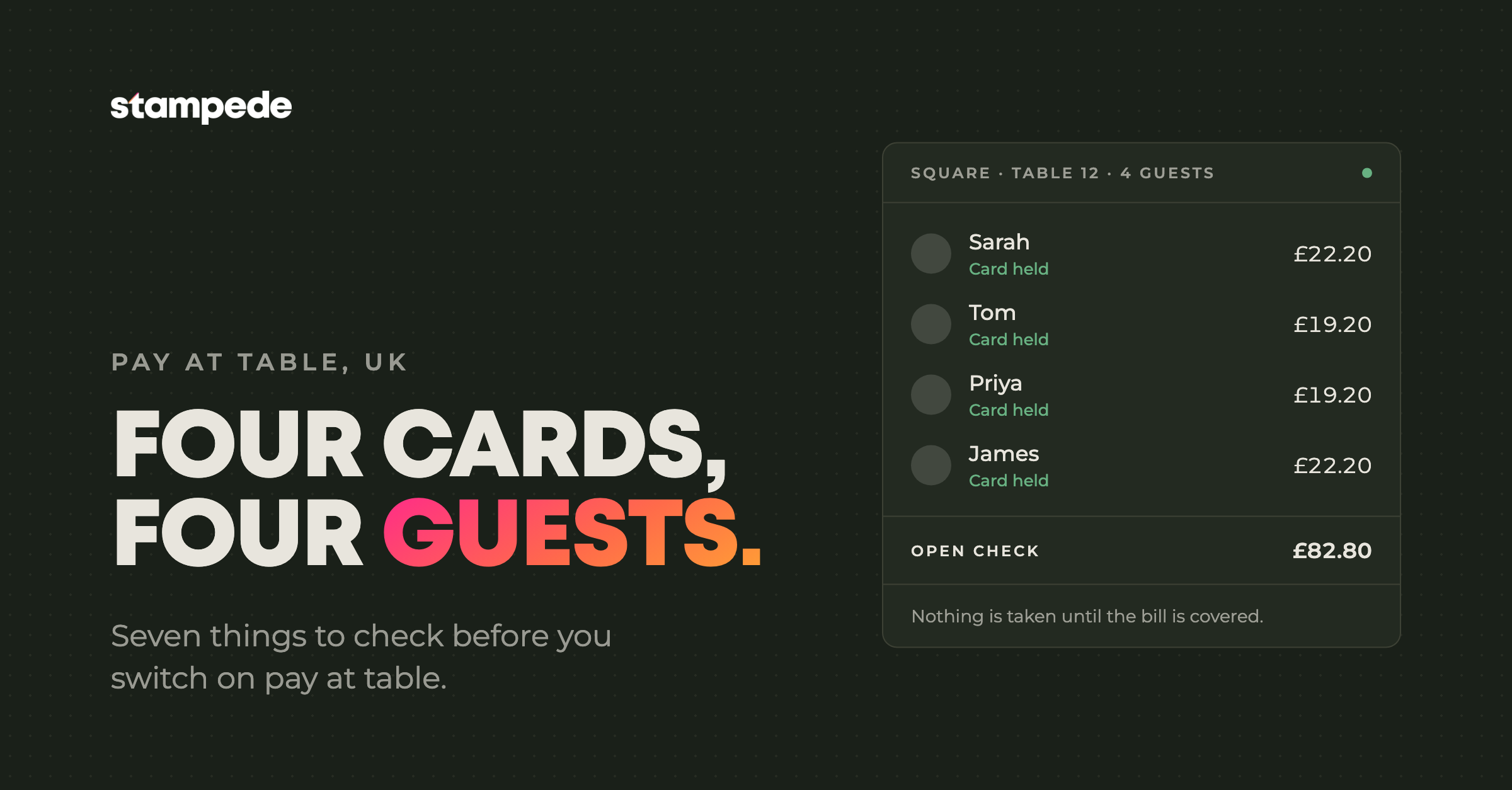
Stampede holds each guest's card for their share through Square, and takes nothing until the whole bill is covered. Then every payment is taken together and Square closes the order. While a bill is part paid, staff see what is left, what is held and what is taken on every table, on the Pay at table page in Connect and on the Day Planner, without opening Square. If the lead booker has left, staff can text them a pay link from the booking.
5. Does it handle tips and service charge the way the Tips Act expects?
Since 1 October 2024, the Employment (Allocation of Tips) Act has required employers in England, Scotland and Wales to pass all tips, gratuities and service charges to workers without deductions, other than in narrow cases such as income tax. A tip paid by card through pay at table counts. The code of practice sets out what an employer must do:
Pay it all on. Tips and service charges reach workers without deductions.
Pay it on time. By the end of the month after the month the guest paid. A tip left on 23 June must be distributed by 31 July.
Write it down. A written tipping policy, available to every worker.
Keep records for three years. Workers can ask to see the record.
Source: Code of practice on fair and transparent distribution of tips, GOV.UK, in force 1 October 2024.
Pay at table does not allocate tips for you. What it must do is record every tip it takes, by bill and by date, so your records are complete. In Stampede, the Pay at table page in Connect shows the tips on every bill alongside the payments, and every tip goes through your Square account with the bill it belongs to.
Service charge and tip on the same bill
A service charge is added to the bill before the guest sees it. A tip is chosen by the guest when they pay. When a bill already carries a service charge, pay at table should not pre-select a tip on top of it. Guests notice being asked to tip twice, and a pre-selected tip on top of a service charge is the fastest way to turn a good meal into a complaint.
Stampede offers preset or custom tips, and when service is already on the bill, no tip is picked for the guest. They can still add one.
6. Do you learn who every guest at the table is?
At the card machine, a table of four leaves one card and no names. Pay at table can capture every guest who pays, but only if it asks for details and the venue owns what it collects. Ask whether it captures every payer or only an email, whether marketing consent starts unticked, and whether you can export the data.
With Stampede, each guest who pays joins the bill with their name, email and phone, so four friends become four guest profiles. The marketing box starts unticked, and guests already signed in to Stampede join in one tap. Each profile carries that guest's bookings, Wi-Fi visits, loyalty and reviews as well, and because the Square integration is two-way, spend from a booked table comes back to the guest who booked it.
The paid screen also asks every guest to rate the food, service, ambience and value, and offers your Google review link. The rating is kept on the guest's profile. Our guide to getting more Google reviews covers what to do with them.
7. Can your team see every open bill?
A server should never need to walk to the POS to find out whether table 12 has paid. Check whether pay at table gives staff a live view of every open bill, and whether it reaches the places they already look.
Stampede shows every QR bill in Connect, live: what is left, held and taken on each table, with a timeline of each bill and receipts that can be resent. On the Day Planner, each booking shows its bill in amber while cards are held, green when it is paid, and red if the POS needs a look. Venues can also print a pay QR on their Square receipts, for guests who sit somewhere without a table code.
When is pay at table the wrong fit?
Pay at table is the wrong fit where presenting the bill is part of the service a guest is paying for, such as a tasting menu or a special-occasion dining room. It also needs a POS it can read from. Stampede's pay at table is built for Square, so it suits venues that take payments on Square Point of Sale.
Most venues land in the middle. Staff still take the order and serve the table, the card machine stays on the bar, and the QR code is there for the table that wants to go. Guests who prefer to pay a person still can.
How does pay at table work with table ordering?
In Stampede, pay at table and order and pay at the table share the same table QR and the same Square menu. If the venue switches it on, a guest can order another round from the bill page, and it goes to the POS on the same bill. For the full feature list, see the pay at table page.
Pay at table FAQs
Can a big Christmas party table split one bill with pay at table?
Yes. Each guest scans the table QR and pays their own items, an equal share or a set amount, and the last guest pays what is left. With Stampede, nothing is taken from any card until the whole bill is covered.
Do tips paid through pay at table count under the Tips Act?
Yes. A tip paid by card through pay at table is a qualifying tip under the Employment (Allocation of Tips) Act, so it must reach staff in full by the end of the following month and appear in your tipping records for three years.
Can guests pay at the table if we already add a service charge?
Yes. The service charge is part of the bill guests split and pay. With Stampede, no tip is pre-selected when a service charge is already on the bill, though a guest can still add one.
What happens if one guest leaves before paying their share?
With Stampede, no card is charged until the bill is covered, so nobody has paid for a bill that is still short. Staff see what is left on the Pay at table page and the Day Planner, and can text the lead booker a pay link from the booking.
Can guests still pay at the card machine once pay at table is on?
Yes. The bill stays an ordinary open check on Square Point of Sale, so staff can take payment on the card machine as before. If part of a bill is paid on the card machine, the QR asks the rest of the table to settle with their server. If staff close a bill on the POS while guests' cards are held, Stampede reduces each hold to what is still owed, or cancels it, so nobody pays twice.
See it running on your venues
One unified guest record across Wi-Fi, bookings, reviews and loyalty, and the marketing that acts on it.